Hot air from the vents in Dubai traffic is not a small inconvenience – it changes your whole day. The good news is that most A/C failures follow a pattern. If you know what to look for, you can avoid wasting money on random “gas top-ups” and get to the real fix faster.
This practical guide walks through a clear, real-world car ac not cooling diagnosis: what you can check safely, what the symptoms usually mean, and when it’s smarter to stop guessing and get proper testing.
Start with the simplest checks (no tools)
Before assuming a major A/C repair, confirm the basics. You’d be surprised how often the “problem” is a setting or airflow issue that feels like weak cooling.
Set the system to MAX A/C (or LO), recirculation ON, and fan speed medium-high. Recirculation matters because it cools cabin air that’s already partially cooled instead of constantly trying to chill hot outside air.
Next, check airflow strength. If air volume is weak even at high fan speed, the A/C may be fine but the cabin air isn’t moving. A clogged cabin air filter is a common culprit, especially in dusty conditions. When it’s restricted, it can feel like the A/C “isn’t cooling” because very little cold air reaches you.
If airflow is strong but temperature is warm, keep going.
Pay attention to the pattern – it points to the fault
A/C issues usually show up in one of a few patterns. The pattern helps narrow the diagnosis without tearing anything apart.
Cold at speed, warm at idle
If it cools while driving but warms up at traffic lights, think heat management and airflow across the condenser.
Common causes include a weak radiator/condenser fan, debris blocking the condenser, or a condenser that’s struggling to reject heat. In Dubai heat, even a slightly weak fan or partially blocked condenser can push the system over the edge at idle.
Cold for a few minutes, then warm
This is often related to pressure control problems. An expansion valve or orifice tube can stick, the compressor control valve can misbehave, or the evaporator can start freezing due to airflow restriction or sensor issues. You might notice airflow slowly dropping too, which can happen when the evaporator ices up.
Never cold, not even for a moment
This usually points to low refrigerant from a leak, a compressor that isn’t engaging, an electrical control issue, or a major restriction in the system.
One side colder than the other
If the driver side is warm but passenger side is cooler (or the opposite), many vehicles are telling you about a blend door actuator problem, a calibration issue, or a restricted heater control. It can also happen when refrigerant charge is off, but cabin temperature door problems are very common.
Listen for compressor engagement
With the engine running and A/C turned on, you may hear a subtle click as the compressor clutch engages (on many vehicles). If it never engages, cooling won’t happen.
A compressor might not engage for several reasons: low refrigerant pressure (the system protects itself), a blown fuse, a faulty relay, a bad pressure sensor, wiring issues, or a compressor/clutch failure.
If you notice the compressor repeatedly clicking on and off every few seconds, that rapid cycling often points to low refrigerant or incorrect pressure readings. It’s a strong sign that topping up without finding the leak is only a temporary bandage.
Check for signs of a refrigerant leak (without guessing)
Refrigerant does not get “used up.” If the charge is low, it escaped somewhere.
You can sometimes spot clues without tools. Look for oily residue around A/C hose connections, the compressor body, or the condenser area. Refrigerant oil travels with the refrigerant, so leaks often leave an oily dirt-trap.
Also pay attention to the smell in the cabin. A musty smell is usually bacterial growth on the evaporator, not a refrigerant leak. A sharp chemical odor can mean other issues, but relying on smell alone is not a reliable diagnostic.
A proper leak diagnosis typically involves UV dye inspection, an electronic leak detector, and pressure testing. That matters because replacing parts without confirming the leak point is the fastest way to pay twice.
Understand what “needs gas” really means
“Needs gas” is one of the most common phrases drivers hear, and it’s also one of the most misunderstood.
Yes, low refrigerant will reduce cooling. But refrigerant level is a measurement, not a root cause. If a shop adds refrigerant without identifying the leak, you can end up back in the same situation in weeks – especially during peak summer.
A correct repair is usually: find the leak, repair or replace the leaking component, replace O-rings as needed, evacuate the system, then recharge by exact weight. “By exact weight” is key. Overcharge and undercharge both reduce cooling and can increase system stress.
When warm air is actually a control problem
Not every no-cooling complaint is a refrigerant or compressor problem. Modern vehicles use actuators and sensors to blend hot and cold air to achieve your set temperature.
If the A/C lines under the hood are cold but the cabin air is warm, the system may be producing cold air but not delivering it properly. Blend door actuators can fail, temperature sensors can read incorrectly, and control modules can lose calibration.
This is where modern diagnostics save time. Reading HVAC codes and live sensor data can quickly confirm whether the system is commanding cooling and whether the temperature doors are moving as intended.
Compressor problems: what they feel like (and why it depends)
Compressors can fail in different ways.
A worn compressor might still engage but produce low pressure differential, giving you “kinda cool” air that never gets truly cold, especially at idle. A failing clutch can slip when hot, so cooling fades after the engine bay heats up.
There’s also a trade-off in how repairs are handled. If a compressor fails internally, debris can contaminate the system. In those cases, replacing only the compressor may not be enough. The correct repair may involve flushing lines, replacing the receiver-drier or accumulator, and sometimes replacing the expansion valve or orifice tube. It depends on what failed and what contamination is present.
Condenser and airflow issues: common in harsh heat
The condenser is the heat exchanger at the front of the car. If it can’t shed heat, the A/C cannot produce cold air effectively.
Bent fins, sand and dust buildup, and minor front-end impacts can reduce condenser efficiency. A weak cooling fan or fan control issue makes it worse at idle.
If your car overheats or the engine temperature climbs in traffic at the same time the A/C gets warm, that’s an important clue. The cooling system and A/C system share airflow and often share fans. Fixing the fan or airflow can restore A/C performance without touching refrigerant.
A quick note on DIY gauges and “recharge cans”
Consumer recharge cans can be tempting when you’re sweating, but they carry real risks.
Low-side pressure alone is not enough to accurately charge a system, because pressure depends on temperature and operating conditions. Overcharging is easy, and overcharge can raise head pressure, reduce cooling, and damage the compressor.
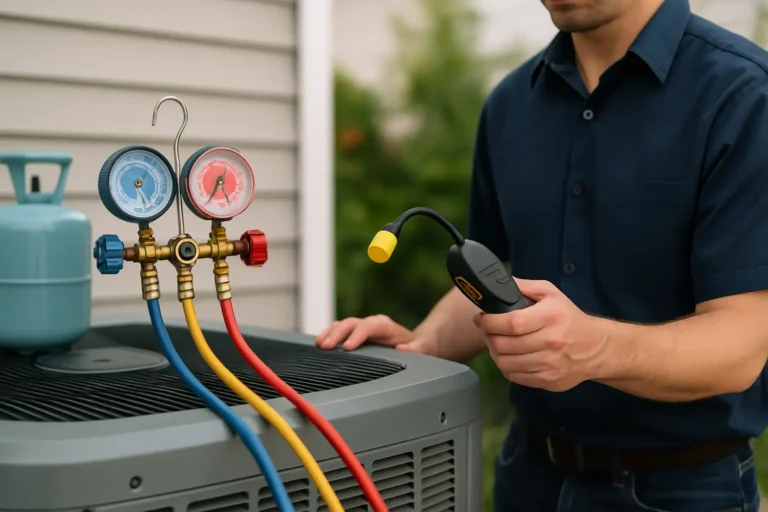
If you want a clean, cost-effective outcome, the most efficient path is usually professional testing: manifold gauge readings on both sides, vent temperature measurements, leak checks, and recovery/recharge by weight.
What a professional A/C diagnosis should include
If you’re paying for diagnosis, you should get clarity – not vague guesses.
A thorough car ac not cooling diagnosis typically includes verifying vent temperature and system command, inspecting condenser airflow, checking fan operation, testing pressures on high and low sides, confirming compressor engagement and control signals, and performing a leak inspection when charge is low.
From there, the repair plan should be specific: what failed, why it failed (if known), what parts and labor are required, and whether anything else needs to be replaced to protect the system.
If you’re near Deira, Abu Hail, or Hor Al Anz and you want this handled quickly with straightforward pricing, Fahad Auto Garage can diagnose and repair A/C issues using modern equipment so you’re not stuck replacing parts on guesswork.
When to stop driving and get it checked now
A weak A/C is often safe to live with briefly, but some signs mean you should book service right away.
If you hear grinding or squealing when the A/C turns on, smell burning, see smoke, or notice the serpentine belt area acting up, stop using the A/C and get it inspected. A locked compressor or failing pulley can damage the belt drive system.
Also, if the engine temperature rises when the A/C is on, don’t ignore it. That can point to fan failure or cooling system strain, which can become an expensive problem fast.
A/C problems are frustrating, especially when you need your vehicle every day. The fastest path back to cold air is simple: follow the symptoms, confirm the basics, and let testing – not guessing – decide the next step.